
Rotator Cuff Dynamics & Scapular Rhythm
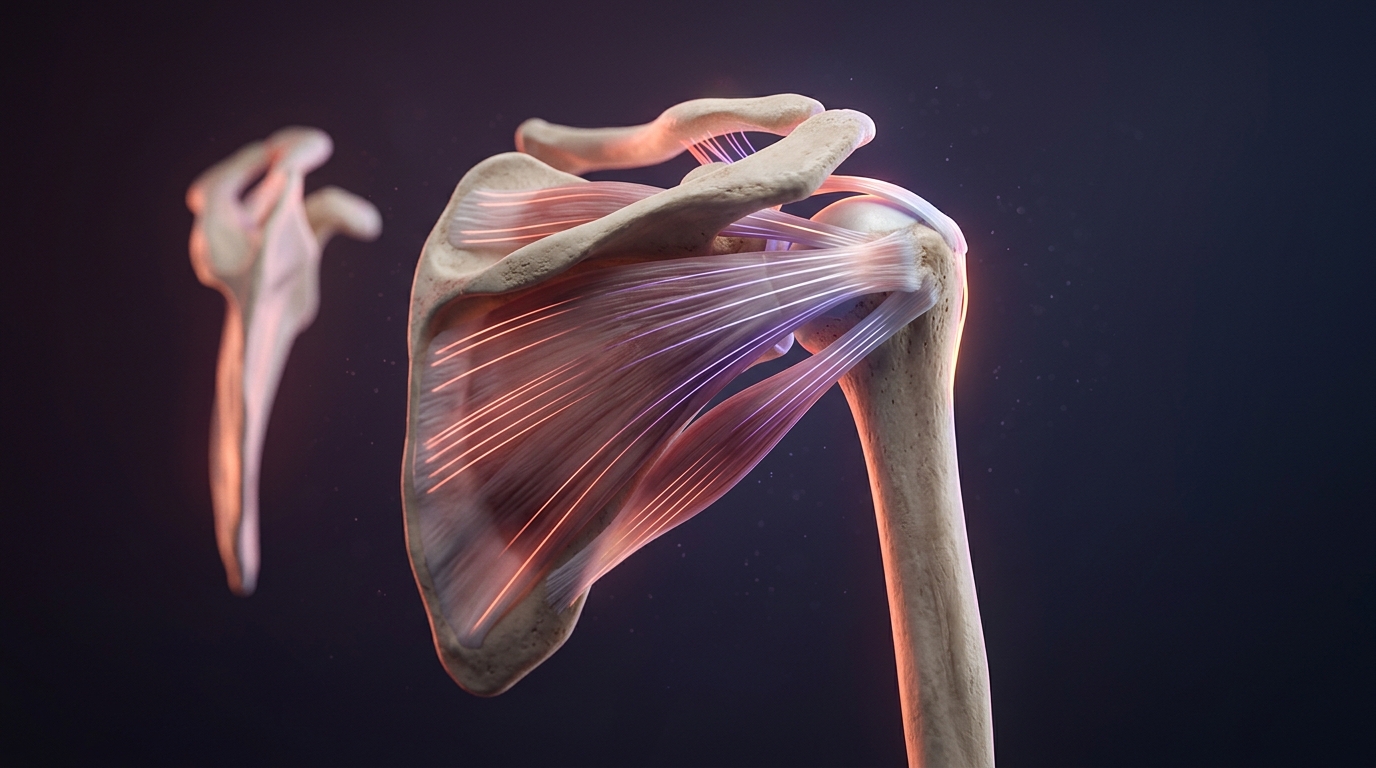
Identify the four rotator cuff muscles and their bony landmarks, then reveal selected scapular and superficial muscles.
Course Syllabus
2 sequential modules covering 4 practical lessons. Select any lesson to enter classroom mode.
Module 1: Glenohumeral Force Couples & Scapular Motion
- 01Rotator Cuff Attachments & Dynamic Stability
Identify all four cuff muscles and compare their actions and innervation.
- 02Scapular Motion & Clinical Observation
Relate scapular muscles to movement without treating asymmetry as a diagnosis.
Module 2: Clinical Pathology & Rehabilitation Protocols
- 01Rotator Cuff–Related Pain: Exercise & Reassessment
Understand active rehabilitation principles without a universal loading prescription.
- 02Glenoid Labrum & Shoulder Stability
Locate the labral rim and distinguish anatomy from a labral diagnosis.
What You Will Achieve
- Identify all four rotator cuff muscles and their actions.
- Compare anterior and posterior shoulder anatomy.
- Describe selected scapular muscle attachments.
- Distinguish movement observations from a tissue diagnosis.
Prerequisites & Target Audience
- Basic anatomical terminology and body planes.
- These materials support study; they do not replace supervised clinical assessment.
Connected Anatomy Tools
Interactive 2D radiological atlases and 3D biomechanical models directly referenced in this curriculum.
Rotator Cuff & Scapular Anatomy Atlas
Identify the four rotator cuff muscles and their bony landmarks, then reveal selected scapular and superficial muscles.
Right Shoulder: Rotator Cuff & Scapular Muscles
Inspect the four rotator cuff muscles with the scapula, clavicle, humerus, deltoid, serratus anterior and trapezius. Source meshes retain their anatomical alignment. Superficial muscles start hidden so the cuff is visible.